WHMIS 2026 Training Requirements Explained
Table of Contents
Introduction
Are you looking for WHMIS 2026 training?
Whether you’re a worker who needs a WHMIS certificate or an employer who needs to train your team, it’s important to understand what WHMIS training actually involves—and whether anything has changed for 2026.
In this guide, we’ll cover whether there’s a “new” WHMIS 2026, what the current WHMIS training requirements are, and the best ways to get certified or train your workforce.
Let’s start with the big question.
Is there a NEW WHMIS 2026?
WHMIS does not update on a yearly basis, and there are currently no changes scheduled for 2026.
The most recent update to WHMIS occurred when Health Canada amended the Hazardous Products Regulations (HPR) in December 2022. Those amendments introduced new hazard classes, updated classification criteria, and revised Safety Data Sheet (SDS) requirements to align with the 7th revised edition of the Globally Harmonized System (GHS), along with certain provisions from the 8th edition.
A three-year transition period followed, ending on December 14, 2025. During this time, suppliers updated their product classifications, labels, and SDSs—and employers needed to ensure their WHMIS programs, workplace labels, and training reflected the amended requirements.
If you’re looking for details on what changed and what employers needed to confirm before that deadline, we covered it in detail here: WHMIS 2025 Deadline: Are You Ready?
Why People Search for WHMIS 2026?
It’s a fair question, and you’re not alone in asking it.
Many people assume WHMIS updates every year because they’ve seen terms like “WHMIS 2015,” “WHMIS 2023,” or “WHMIS 2025” being used both online and off.
Here’s where that comes from:
WHMIS 2015 was a real and significant update. It marked Canada’s alignment with GHS and introduced major changes to labels, SDSs, and hazard classification.
For years, it was important to distinguish between the “old” WHMIS (1988) and the “new” WHMIS (2015).
WHMIS 2023 is sometimes used to describe the December 2022 amendments, since the updated regulations were published in the Canada Gazette on January 4, 2023.
WHMIS 2025 typically refers to the end of the transition period—not a new version.
The confusion is understandable. But the reality is that WHMIS doesn’t follow a yearly release cycle. It gets updated when Health Canada amends the regulations, which happens infrequently.
So if you searched for “WHMIS 2026 training,” you’re in the right place—but what you actually need is current WHMIS training that reflects the amended requirements now in effect.
If you’re new to WHMIS entirely, let’s do a super-quick recap on what it is.
What is WHMIS?
WHMIS stands for the Workplace Hazardous Materials Information System. It’s Canada’s national standard for communicating health and safety information about hazardous products used in workplaces.
The system is built on three core components:
- Labels – Standardized information on product containers that identify hazards at a glance, including pictograms, signal words, and hazard statements.
- Safety Data Sheets (SDSs) – Detailed 16-section documents that provide comprehensive information about a product’s hazards, safe handling procedures, storage requirements, first aid measures, and more.
- Worker Education and Training – Information and instruction that helps workers understand how to read labels, interpret SDSs, and apply safe work practices when using or working near hazardous products.
WHMIS is implemented through coordinated federal, provincial, and territorial legislation.
While Health Canada oversees the supplier-side requirements (classifications, labels, SDSs), each province and territory enforces employer and worker obligations through their own occupational health and safety regulations.
The goal is simple: make sure everyone who works with or around hazardous products has the information they need to stay safe.
What Does WHMIS Training Cover?
WHMIS training is made up of two distinct components: general training, often referred to as education, and workplace-specific training. Both are required, and they serve different purposes.
General WHMIS Training
This is the foundational training that can apply across all workplaces. It covers how WHMIS works and gives workers the knowledge they need to understand hazard communication tools.
Topics typically include:
- WHMIS legislation and the duties of suppliers, employers, and workers.
- Hazard classification.
- WHMIS pictograms and what they represent.
- How to read and understand supplier and workplace labels.
- How to read Safety Data Sheets.
- General safe work practices for hazardous products.
General training can be delivered through classroom instruction or online training, and It typically takes about one to one-and-a-half hours to complete.
This is the portion of training that services like OnlineWHMIS.ca provide.
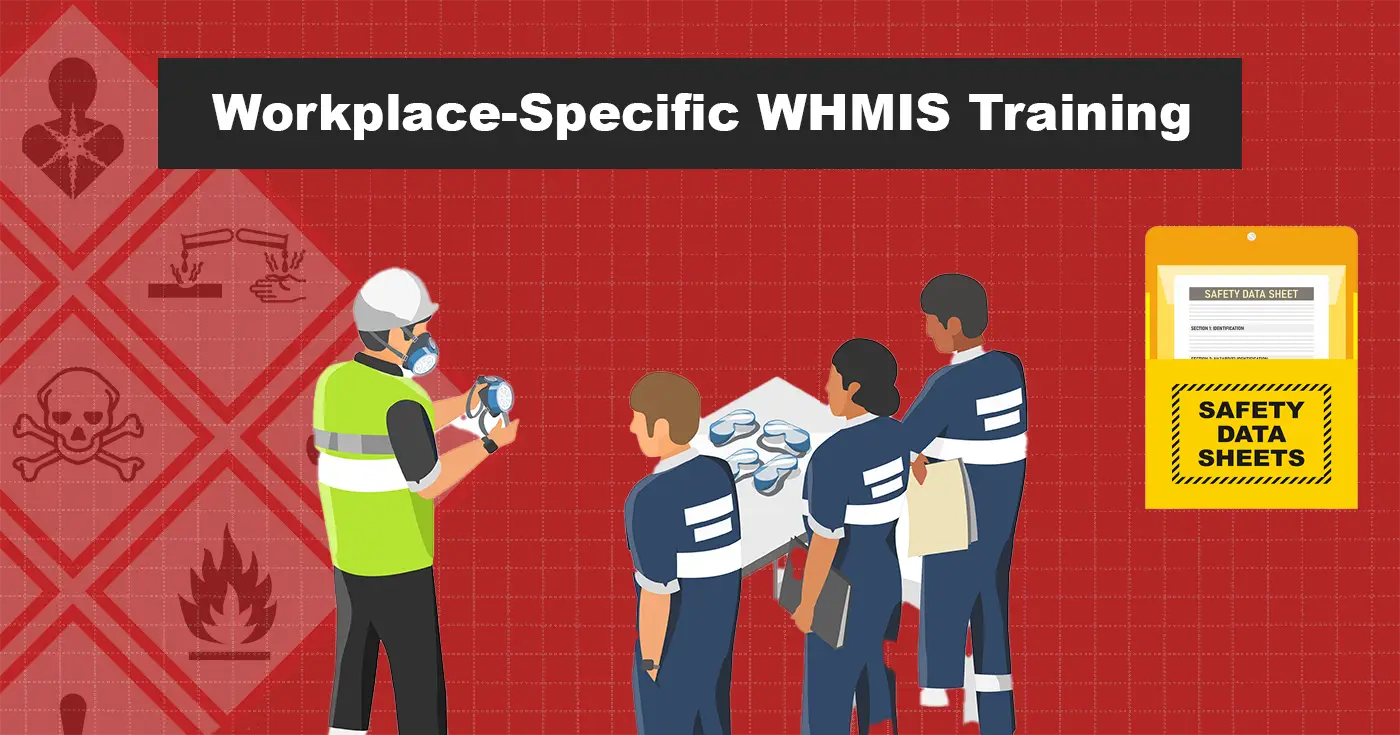
Workplace-Specific WHMIS Training
This component must be provided by the employer and tailored to the specific hazards, products, and procedures in the employer’s workplace.
It covers things like:
- What hazardous products are used or stored here?
- What are the specific health and safety risks associated with those products?
- What safe handling, storage, and disposal procedures must be followed?
- What personal protective equipment (PPE) is required, and how is it used?
- What should workers do in the event of a spill, exposure, or emergency?
One of the most effective ways to design and deliver workplace-specific training is by reviewing the relevant sections of the SDSs for the products your team actually uses. The SDS contains detailed guidance on hazards, protective measures, and first aid—everything a worker needs to handle the product safely.
The depth and duration of workplace-specific training will vary depending on your industry, the types of products involved, and the tasks your workers perform.
Both Components Are Required
General WHMIS training gives workers the tools to understand WHMIS. Workplace-specific training shows them how to apply that knowledge in their actual work environment.
Skipping either one leaves gaps—and gaps lead to unsafe conditions, incidents, injuries, and fines.
Who Needs WHMIS Training?
The Question, Who Needs WHMIS Training, is asked frequently. Quite simply, if you work with hazardous products—or work in an environment where they’re used or stored—you need WHMIS training.
This applies to:
- Workers handling chemicals, cleaning products, fuels, solvents, or other hazardous materials.
- Employees in manufacturing, construction, healthcare, laboratories, automotive, agriculture, and many other industries.
- Office workers in facilities where hazardous products are present (even if they don’t use them directly).
- New hires entering any workplace where hazardous products exist.
- Supervisors and managers responsible for overseeing workers who use hazardous products.
How Often is WHMIS Training Required?
Does WHMIS training expire? There’s no specific legislation in Canada that mandates a fixed renewal period for WHMIS training.
Instead, employers are responsible for ensuring their workers are adequately trained—and that training is updated when circumstances change.
That said, best practices and industry recommendations generally suggest:
- Annual refresher training for workers who regularly handle hazardous products.
- Training updates whenever new products are introduced, procedures change, or new hazards are identified.
- Retraining if a worker is assigned to a new role with different hazard exposures.
It helps to think of WHMIS training frequency as a spectrum—not a pass/fail checkbox.
- Workers who receive annual training are more likely to retain what they’ve learned, recognize hazards, and make safe decisions in the moment.
- At two years, the details start to fade—workers may hesitate, second-guess, or miss something they would have caught a year earlier.
- Beyond three years, the gaps become significant. Information gets forgotten, habits slip, and the risk of incident or injury increases.
From a compliance standpoint, the pattern is similar.
Employers who train regularly are better positioned to demonstrate due diligence if something goes wrong.
Those who let training lapse may find it harder to show they took reasonable steps to protect their workers—especially if an inspector or investigator comes asking questions.
The bottom line: more frequent training means workers are better prepared and employers are better protected. There’s no magic number in the legislation, but the closer you stay to annual refreshers, the stronger your position on both fronts.
WHMIS Training Options
Getting WHMIS training has never been more accessible. Whether you’re an individual worker or an employer responsible for a team, there are flexible options to fit your needs.
For Workers
If you need to get your WHMIS certificate—whether for the first time or as a refresher—online training is a convenient and widely recognized option.
With online WHMIS certification, you can:
- Complete the training at your own pace, from any device.
- Receive your certificate instantly upon passing.
- Finish in about an hour without scheduling conflicts or travel.
Online training is accepted by employers across Canada, including many of the country’s largest companies.
For Employers
If you need to train your workforce, you have several options depending on your team size, industry, and internal resources:
- Online Training Programs – Scalable solutions that let you enroll workers individually or in bulk, track completion, and maintain training records automatically. View Online Training
- SCORM WHMIS Training – The benefits of online WHMIS training, but on your internal learning management system or HRIS. View WHMIS SCORM Package Options
- Instructor-led Training (Train-the-Trainer) – In-person sessions delivered via a traditional, classroom training session. View Train-the-Trainer and Instructor Packages
- Training Videos – Streaming and downloadable videos that can be presented to a group of workers similar to classroom training, but with easier facilitation. View WHMIS Video Options
Many employers use a combination of these—online training for the general training component, supplemented by in-house sessions for workplace-specific instruction by instructor’s who’ve completed a train-the-trainer course.
Conclusion
There’s no new “WHMIS 2026.” The system in place today reflects the December 2022 amendments to the Hazardous Products Regulations, and now that the transition period has ended, this is simply WHMIS—no version number required.
But that doesn’t mean training stops being important.
Workers still need to understand how to read labels, interpret SDSs, and protect themselves from hazardous products. Employers still need to provide both general and workplace-specific WHMIS training. And everyone benefits from keeping that knowledge current.
If you’re a worker looking to get certified or refresh your training, online WHMIS certification is a fast, flexible option you can complete in about an hour.
If you’re an employer looking to train your team, we offer online training solutions, videos, and instructor programs to fit your needs.
Not sure which option is right for you? Reach out via live chat or our contact page—we’re happy to help.
Frequently Asked Questions
Is there a new WHMIS for 2026?
No. WHMIS does not update annually. The most recent changes came into force in December 2022, with a transition period that ends on December 14, 2025. There are no new WHMIS requirements for 2026.
What is the current version of WHMIS?
WHMIS no longer uses version years. The current system reflects the amended Hazardous Products Regulations that came into force in December 2022, aligned with the 7th revised edition of the GHS (plus parts of the 8th). It’s simply referred to as “WHMIS.”
How often is WHMIS training required?
There’s no legislated renewal period, but safety professionals and industry experts often recommend annual refresher training—especially for workers who handle hazardous products regularly. Training should also be updated whenever new products or procedures are introduced.
What’s the difference between general and workplace-specific training?
General WHMIS training (education) covers how WHMIS works—labels, SDSs, pictograms, and hazard classes. Workplace-specific training covers the actual products, hazards, and procedures in your specific work environment. Both are required.
Does supervisors need WHMIS training in 2026?
Yes. Supervisors in Canadian workplaces must receive WHMIS training if they oversee employees who work with or around hazardous products. This training ensures supervisors can promote, enforce, and support WHMIS compliance, as required by law.
At OnlineWHMIS.ca, we offer a comprehensive course specifically designed to support supervisors in promoting and enforcing WHMIS requirements. You can learn more here: WHMIS for Managers and Supervisors
Does my WHMIS certificate need to say “2026” on it?
No. WHMIS certificates don’t need to display a year. What matters is that your training reflects the current WHMIS requirements and is supplemented by workplace-specific instruction from your employer.