How to Implement a Multi-Location WHMIS Training Program
The Complete Guide to Worker WHMIS Training and Certificate Management Across Multiple Facilities and Canadian Worksites
Table of Contents
Multi-Location WHMIS Training Introduction
Training and certifying workers on WHMIS can be challenging enough with a single worksite and just a few employees. Most employers using traditional training methods struggle to schedule classroom sessions, keep training records organized, and only discover training gaps after an incident or an audit.
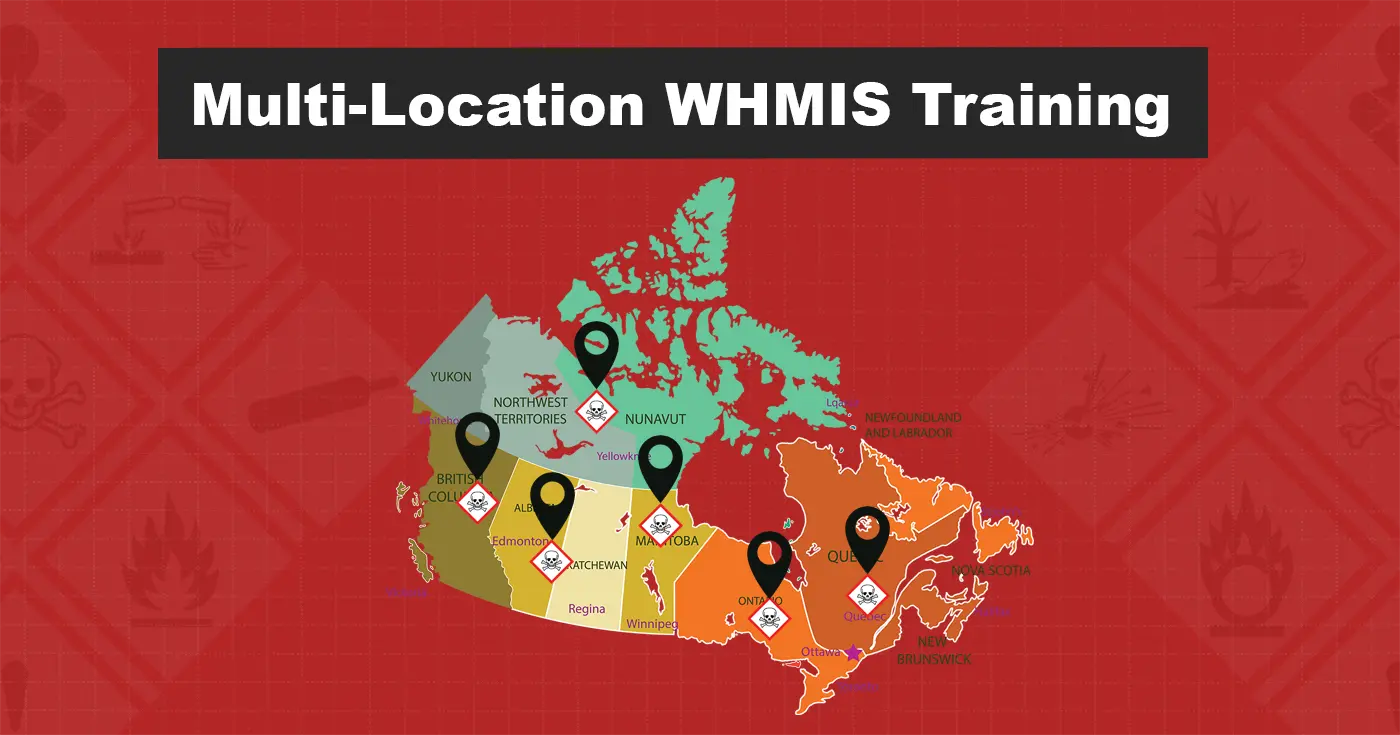
Training workers at multiple locations amplifies those challenges significantly, making it seem impossible to run a WHMIS training program that keeps workers safe and meets Federal and Provincial training requirements.
Multi-location WHMIS training breaks down because it becomes difficult to coordinate and manage the training process across sites, shifts, and hiring cycles. Classroom sessions are hard to schedule, workplace-specific WHMIS training is hard to complete consistently, and recordkeeping often ends up scattered across different managers, spreadsheets, and paper files.
When training is difficult to facilitate and track, workers get missed. Workplace-specific training gets delayed or skipped. Certifications become outdated. The company loses clear visibility into which employees are trained and at which location. That is how training gaps develop across multi-location operations, even when employers have good intentions and strong policies.
In this guide, we will break down the challenges of managing WHMIS training across multiple sites in detail. We’ll also show you the training method you can use to train your workers in WHMIS at every location using your own team.
This method also ensures full compliance with the updated WHMIS requirements under Canada’s Hazardous Products Regulations (HPR) and applicable provincial and territorial occupational health and safety legislation.
Before looking at those challenges and solutions in detail, it is important to cover the core WHMIS training requirements. That framework is what defines what an effective multi-site training program has to deliver at every location.
WHMIS Training Requirements
Regardless of which Canadian provinces or territories your locations operate in, WHMIS training requirements generally include two core components:
- General WHMIS Training: This part of the training covers WHMIS fundamentals, hazard classification, labels, safety data sheets, and general safety principles. It’s the “classroom” portion of the training, which can be completed via traditional instructor-led training or online training.
- Workplace-Specific WHMIS Training: This part of the training is completed in the workplace and covers the specific hazardous products workers will encounter at their location, site-specific handling procedures, emergency response protocols, and location-specific safety guidelines.
Employers are responsible for ensuring both components are completed and documented for each worker at every company location. The general training provides foundational knowledge, and the workplace-specific training applies that knowledge to the actual hazardous products and hazards workers will face.
WHMIS Training Language and Comprehension
WHMIS training must be provided in a language that workers can understand. This means employers must ensure workers comprehend the training. If you’re training French-speaking workers, you need to provide them with French-Canadian WHMIS training.
Multi-Location WHMIS Training Challenges
Managing WHMIS training across multiple locations amplifies the coordination, consistency, and documentation challenges that already exist with worker training. Scheduling becomes exponentially more complex. Training quality varies between sites. Records end up scattered across different systems and locations. Costs multiply as the operation scales.
The most common challenges multi-location operations face include:
- Inconsistent Training Quality: Training quality and delivery consistency vary significantly between locations when each site handles training independently or uses different providers. One site might conduct thorough classroom sessions covering all WHMIS elements while another uses an online course with questionable quality. Workplace-specific WHMIS training varies from detailed site walkthroughs to informal verbal instructions. Workers across your organization end up with completely different levels of training, creating both safety risks and compliance gaps.
- Scheduling Nightmares: Coordinating classroom sessions across multiple sites, shifts, and time zones is nearly impossible. New hires wait weeks for training because the external training company is scheduled elsewhere. Production demands force constant rescheduling. Workers either sit idle waiting to be trained, or they start working without proper WHMIS training, with increased risk of injury and illness. Neither scenario is acceptable.
- Costs Multiply Fast: Traditional training costs scale badly. $50 per worker for consultant-led WHMIS training can become $10,000 for 200 workers, and you still have to complete workplace-specific training at your site.
- Poor Documentation: Training records and WHMIS certificates are scattered across locations (if they even exist). When an inspector shows up for an audit or after an incident, you can’t show proof of WHMIS training or produce WHMIS certificates for your workers.
- Zero Visibility: Managers can’t see WHMIS training status across the operation. Which workers need refresher training? Which locations have gaps? These questions require manual data gathering from each site, if the data even exists in a usable format.
- Workplace Hazard Training Gaps: Workplace-specific training is skipped, rushed, or improperly documented because it takes time and requires someone knowledgeable about site hazards. Busy sites prioritize production over thorough onsite training. Workers may complete general WHMIS training but never receive proper instruction on the specific hazardous products they will actually handle. This is where compliance breaks down most often.
- Training Delays Kill Flexibility: New hires wait for scheduled sessions before they can work with hazardous products. Workers who need immediate refresher training after an incident must wait days or weeks. When demand spikes and you need to scale up quickly, hiring happens faster than training, creating a bottleneck that limits operational capacity exactly when you need it most.
Why Traditional WHMIS Training Doesn’t Scale
Most traditional WHMIS training approaches were designed for single-site operations and break down when applied across multiple locations. Here’s why the most common models fail:
Offsite Training Centers
With this method, workers are sent to external training centers to complete WHMIS training and then return to work. This approach is expensive and logistically complex, especially for multi-location operations.
Coordinating which workers from which sites attend which sessions becomes a scheduling nightmare. Training centers are not equally accessible from all locations.
Most importantly, external training centers cannot provide workplace-specific hazard training on the specific products workers will actually handle at their location, which means workplace-specific training still needs to happen at each site anyway.
Companies pay for external training and still have to complete a critical component internally, which means the perceived value proposition of “complete certification” that external training centers offer doesn’t actually exist.
The Site-by-Site Independence Model
The site-by-site independence model allows each location to handle training independently either by hiring local providers or running their own programs. This eliminates coordination issues but creates immediate consistency problems.
Site A uses Provider X with one training approach. Site B uses Provider Y with a completely different curriculum. Site C has a supervisor deliver informal training without proper documentation. Documentation systems differ at every location. There are no standardized training records.
Training quality varies dramatically across the organization. Management has no visibility into what is actually happening at each site. When an audit occurs or an incident happens, the company can’t demonstrate consistent training standards because consistent standards do not exist.
The Traveling Trainer Model
With this approach, the company uses a single internal trainer who travels between sites to conduct WHMIS training sessions. This can work for one or two nearby locations with low training volume, but has significant downsides with more than a few locations and workers.
For example, new hires at Site A wait while the trainer is scheduled at Site B. The trainer spends more time traveling than training. If the trainer is unavailable due to vacation or leaves the company, the entire training program stops across all locations.
Travel costs add up quickly. The trainer never becomes as familiar with site-specific hazards and products as someone who works there daily. Most importantly, this model creates a single point of failure. When the trainer is unavailable, training stops everywhere.
WHMIS Certificate and Recordkeeping Breakdowns
Traditional training creates certificate problems across multiple locations. Certificates get scattered, manual tracking fails, and compliance gaps happen even when training was completed.
What Multi-Location WHMIS Training Programs Actually Need
Multi-location WHMIS training programs need to accomplish what traditional approaches can’t: deliver consistent, Canadian standards-compliant training quality across all sites while maintaining the flexibility to handle site-specific requirements without multiplying costs or complexity.
Here’s what that means in practice:
Standardized General WHMIS Training: Every worker, regardless of location, should receive identical general training on WHMIS fundamentals, hazard classification, labels, safety data sheets, and general safety principles. This should not vary by site, provider, or trainer preference.
Site-Specific Workplace Hazard Training: Each location must be able to conduct workplace-specific hazard training on the actual hazardous products workers will handle, in the actual work environment, without waiting for external trainers or coordinating across the organization.
Knowledgeable Personnel at Each Location: Sites need their own personnel who understand local hazards, products, and procedures. These individuals must be properly prepared to deliver workplace-specific hazard training that meets regulatory standards.
Immediate Availability: Training must happen when it’s needed, not when external providers are available. New hires should be able to start training immediately. Refresher training should happen the same day it’s required.
Centralized Documentation and Records: Training records must be accessible across all locations, not stored in local spreadsheets, paper files, or disconnected systems.
Cost Structure That Scales: Training costs should remain manageable and predictable as the operation grows, not multiply uncontrollably with each new location or hiring wave.
Internal Control: The company must control when WHMIS training happens, who delivers it, and how it’s conducted, without dependency on external providers or consultants.
Full Regulatory Compliance: The training program must meet all requirements of the updated WHMIS, the Hazardous Products Regulations, and applicable provincial/territorial OHS legislation, including both general WHMIS training and workplace-specific hazard training. This compliance must be verifiable at every location through consistent documentation practices.
WHMIS Certificate Management Across Multiple Locations
WHMIS certificates are the simplest way to prove a worker has completed training. They’re what get referenced during inspections, internal audits, and when supervisors need to confirm training status before assigning work involving hazardous products.
Multi-location operations don’t usually fail because they don’t train, they fail because they can’t prove who was trained, where, and when.
This is why any multi-location WHMIS training program needs a streamlined WHMIS certificate management and access system that includes:
- Automatic Certificate Issuance: Proof of training should be generated immediately and automatically when a worker completes general WHMIS training. If certificates require manual processing, they will fall behind, especially across multiple sites and hiring cycles.
- Centralized Certificate Storage: Certificates should be stored in one consistent system across all locations. If each site keeps their own folders, spreadsheets, or paper copies, proof becomes unreliable and gaps become inevitable.
- Fast Certificate Retrieval: Managers and supervisors need to be able to pull up proof of training quickly during audits, inspections, internal reviews, or worker transfers, without having to call other locations or searching through email threads.
- Self-Serve Access for Workers: Workers need the ability to retrieve their own certificates when requested, without creating admin work or delays. Multi-location operations can’t afford constant “can you resend my certificate?” issues across multiple sites.
- Organization-Wide Visibility: Multi-site managers must be able to see certificate status across all locations including who is trained, who isn’t, and where gaps exist, without manually collecting records from each facility.
- Consistent Documentation Format: Certificates should be consistent across the organization. A standardized format makes audits cleaner, reduces questions from inspectors, and prevents the “Site A documentation looks nothing like Site B” problem.
- Audit-ready Proof at Any Location: Any facility should be able to produce certificates, completion dates, and training records immediately, without having to rely on local managers to have “kept things organized.”
It’s hard to achieve all of this at once when you’re using traditional training methods since they force you to choose between consistency and flexibility, or between control and cost-effectiveness.
However, there is a training approach specifically designed to deliver all of these requirements at once across multi-location operations.
The Best Way to Implement Multi-Location WHMIS Training
The most effective approach to multi-location WHMIS training is one that standardizes what should be consistent while allowing each site to handle what must be site-specific.
General WHMIS training on routes of entry, hazard classification, labels, safety data sheets, and safety principles should be identical across all locations. Workplace-specific WHMIS training should be conducted locally, on the actual hazardous products workers will be exposed to, by personnel who understand the specific work environment at that site.
This is exactly what the blended WHMIS training method accomplishes. It combines online training for the general WHMIS component with knowledgeable WHMIS trainers at each location who conduct the workplace-specific training.
The result is a training program that maintains consistency across your entire operation while giving each site the flexibility to train workers on their schedule, with their products, in their environment.
What is Blended WHMIS Training?
Blended WHMIS training combines two training methods to cover the WHMIS training components that each of your workers at all locations require:
Training Method 1: Online WHMIS Training
General WHMIS training is delivered entirely online, and workers complete it independently, at their own pace. The online training covers WHMIS fundamentals, hazard classification, labels, safety data sheets, and general safety principles. The required knowledge assessment is integrated directly into the online training, eliminating the need for live testing and grading. It’s completely automatic.
Training Method 2: Workplace-Specific Hazard Training
The workplace-specific hazard training is conducted in person, at your facilities, by someone from your team. This covers the specific hazardous products at that location, site-specific handling procedures, storage requirements, emergency response protocols, and location-specific controls and PPE requirements.
Combining the Two Methods
Online training delivers consistent, comprehensive WHMIS instruction to every worker, across all of your locations, without the logistical headaches of classroom scheduling. Your internal trainers then handle the workplace-specific hazard training component.
Who Can Deliver Workplace-Specific Hazard Training
Workplace-specific hazard training should be conducted by persons who are knowledgeable about the workplace, the hazardous products present, and the procedures for safe handling. This does not require hiring an outside consultant or coordinating external trainers to visit each of your locations. In fact, it’s best if it’s an employee at each site, as long as they have the necessary knowledge.
Here are some examples of individuals at each of your sites who can fill this role:
Supervisor
Supervisors typically possess a comprehensive understanding of workplace operations and the hazards workers may encounter at their specific location. With their knowledge and experience, they are well-positioned to deliver workplace-specific hazard training effectively.
By enhancing their fundamental WHMIS knowledge and teaching abilities through a train-the-trainer program, they can more effectively communicate workplace-specific WHMIS requirements when handling hazardous products.
Experienced Worker or Joint Health and Safety Committee Member
An experienced worker who regularly handles or works around hazardous products can also make an effective WHMIS trainer.
These individuals often bring:
- Direct hands-on experience with the products and processes used on-site.
- Practical insight into exposure risks and controls.
- Strong credibility and trust with coworkers.
That said, experienced workers aren’t always accustomed to training others, let alone in WHMIS and other potentially complex safety topics.
With additional guidance and a structured approach, such as a WHMIS train-the-trainer program, their real-world experience can be translated into clear, job-relevant instruction that aligns with WHMIS expectations and workplace procedures.
Health & Safety Manager or Coordinator
A health and safety manager or coordinator at a site can bring a comprehensive understanding of workplace hazards and can easily integrate WHMIS training into the company’s overall safety program at that location.
They typically maintain safety data sheets, understand site-specific hazards, and are familiar with emergency procedures, making them ideal candidates to deliver workplace-specific WHMIS training.
Choosing the Right Personnel
The best individuals to deliver workplace-specific hazard training are those who already have an in-depth understanding of their workplace, the hazardous products present, and site-specific procedures. This is what makes site-based personnel more effective than traveling external providers.
With the right tools and preparation, supervisors, safety coordinators, and experienced workers within your organization can leverage their existing knowledge to deliver effective workplace-specific hazard training at their respective locations. They can provide training that is relevant, practical, and immediately applicable to the actual hazards workers will encounter.
Single WHMIS Trainer vs. Multiple Trainers
One of the most important decisions in implementing a multi-location WHMIS training program is determining your training structure.
Should you have one person who travels between sites to deliver training, or should you develop knowledgeable personnel at each location?
The answer depends on the size of your operation, but for most multi-location companies, having knowledgeable personnel at each site is the more effective approach and gives you the full benefits of a blended training method.
The Single Traveling WHMIS Trainer Model
With the single trainer model, one person is responsible for conducting WHMIS training across all locations. This person travels to each site on a schedule to complete both general training and workplace-specific training, and may be in this role full time.
This approach can work for very small operations with only one to two sites in close proximity and with low training volume. However, this model has significant limitations when attempting to use it for larger companies with multiple locations, including:
- Scheduling Delays: New hires must wait for the trainer’s next scheduled visit to that location. If Site A needs training on Monday but the trainer is scheduled at Site B for the week, training is delayed, which leaves workers unable to start working without risking injury or illness.
- Coverage Gaps: If the trainer is unavailable due to vacation, illness, or departure from the company, the entire training program across all locations stops until a replacement is found.
- Travel Costs and Time: The trainer spends significant time traveling between locations rather than delivering training. Travel expenses add up quickly, especially for geographically dispersed operations.
- Limited Site Familiarity: A traveling trainer may not be as familiar with the specific hazardous products, procedures, and site-specific controls at each location as someone who works at that site daily.
- Inflexibility for Urgent Training Needs: If a worker at one location needs immediate training due to a new product introduction or incident, the company must either wait for the trainer’s next visit or disrupt the trainer’s existing schedule to get them onsite immediately. Neither scenario is ideal.
WHMIS Trainers at Each Location Model
With this model, each site has WHMIS trainers who can conduct workplace-specific hazard training at that location. These individuals are typically supervisors, JHSC members, safety coordinators, or experienced workers who already work at the site and understand the hazards and procedures.
This structure provides several advantages, including the following:
- Immediate Availability: New hires can complete workplace-specific hazard training as soon as they finish the online WHMIS training component. There’s no waiting for a trainer to visit from another location. This results in workers being able to start their jobs faster.
- Coverage and Redundancy: Sites can have multiple trainers to cover different shifts, vacations, or turnover. If one person leaves the company, others remain available to deliver training.
- Site and Hazard Familiarity: Trainers are employees who work at the location daily and are intimately familiar with the specific hazardous products, procedures, storage areas, emergency equipment, and site-specific controls workers will encounter.
- Flexibility for Immediate Training: When a worker needs training due to a new product introduction, incident, or job change, it can be handled immediately rather than waiting for a scheduled visit.
- Scalability: As the company opens new locations, each site develops its own training capability. The training program scales naturally without adding burden to a single centralized trainer.
- Lower Long-Term Costs: While there can be an initial time and cost investment with having trainers at each facility, the ongoing cost is significantly lower than maintaining a traveling trainer position with travel expenses.
Single Traveling Trainer |
Trainers at Each Location |
|
| Scheduling flexibility | Low – Must coordinate trainer visits across all sites | High – Training is available on-demand at each location |
| Onboarding speed | Slow – New hires wait for next scheduled visit | Fast – New hires complete training immediately |
| Coverage during absences | None – Training stops if trainer is unavailable | High – Multiple personnel provide redundancy |
| Site familiarity | Limited – Trainer rotates between sites | High – Personnel work at the site daily |
| Travel costs | High – Ongoing travel between locations | None – Personnel are already on-site |
| Scalability | Poor – One person cannot effectively cover several locations | Excellent – Each new location adds its own capability |
| Response time for urgent training | Slow – Must wait for next visit | Immediate – Personnel are on-site |
Making the Decision
For most multi-location operations with more than two or three sites, the answer is clear: develop WHMIS trainers at each location.
This builds internal capability that scales with the business rather than creating a bottleneck that limits growth. WHMIS trainers who understand local hazards can deliver more relevant, practical workplace-specific WHMIS training than any traveling trainer could.
The only situations where a single traveling trainer could make sense are very small operations with two or three sites in close proximity, low training volume, and minimal turnover. Even in those cases, the benefits and flexibility that blended training brings will be limited.
WHMIS Train-the-Trainer
Supervisors, JHSC members, health and safety coordinators, experienced workers, and site managers bring valuable workplace knowledge to the table. However, there’s a distinction between understanding your facility’s operations and knowing WHMIS requirements comprehensively and how to deliver effective workplace-specific WHMIS training.
A WHMIS train-the-trainer program helps bridge that gap. It equips site personnel with comprehensive WHMIS knowledge, hazard communication techniques, and a structured approach to delivering workplace-specific training, enabling them to train workers with confidence and consistency across all locations.
Benefits of Enrolling Your Site WHMIS Trainers in the Program
Having your internal trainers complete a WHMIS train-the-trainer program provides several benefits that are particularly valuable for multi-location operations:
Strengthens WHMIS Knowledge and Training Skills: A WHMIS train-the-trainer program deepens understanding of WHMIS fundamentals, including hazard classification, labels, safety data sheets, and general safety principles. It also provides personnel with practical training techniques, enabling them to communicate hazard information clearly and engage workers effectively across all sites.
Ensures Compliance with WHMIS Requirements: Internal trainers who complete a structured WHMIS train-the-trainer program are better equipped to deliver consistent, Canadian standards-compliant workplace-specific hazard training that meets both WHMIS requirements and site-specific needs. This helps companies maintain compliance across all locations while improving overall safety.
Enhances Hazard Communication Skills: The program helps prepare personnel to effectively communicate hazard information, interpret safety data sheets, and explain site-specific procedures. Personnel learn to identify knowledge gaps, provide clear instructions, and ensure workers understand the hazards they’ll encounter.
Saves Time and Resources: Developing trained personnel at each location eliminates the need for costly external training providers or traveling trainers. By empowering employees as internal trainers, companies can streamline their training programs, reduce travel costs, and minimize downtime across their entire operation.
Creates Consistent Training Standards: When personnel across multiple locations complete the same train-the-trainer program, they learn the same WHMIS principles, hazard communication methods, and training practices. This creates consistency in how workplace-specific hazard training is delivered and documented, regardless of which site a worker is at.
Benefits of Using Blended WHMIS Training for Multiple Locations
At this point, you understand what blended WHMIS training is, how it works, and who can deliver it. Here’s why this method is so effective for multi-location operations and is used by companies that need to maintain consistency, ensure compliance, and scale their training programs across multiple facilities.
Consistency and Standardization Across All Locations
Blended training solves the consistency problem that plagues multi-location operations. Every worker, regardless of which site they work at, completes the exact same, high-quality online WHMIS training covering WHMIS principles, hazard classification, labels, safety data sheets, and safety principles. This standardization ensures that a worker trained at your Ontario facility receives the same foundational knowledge as a worker trained at your Alberta facility.
Complete Control Over Your Training Program
You decide who delivers training, when training happens, and how it’s conducted at each location. No coordinating with outside vendors across multiple sites. No waiting for scheduled sessions from traveling trainers. No dependency on consultants who may not understand your products or operational needs. Your team, your schedule, your facilities.
This control extends to rapid response when training needs arise. If a location needs to onboard 10 workers immediately, training starts immediately. If a worker needs refresher training due to an incident, it happens that day.
Scalable Across All Industries and Every Company Size
Whether you’re training 20 workers at three manufacturing facilities or 5,000 workers across fifty locations, the process is the same. This approach works across industries, from manufacturing and warehousing to healthcare, laboratories, construction, and transportation. Online training scales infinitely, and your internal trainers handle the workplace-specific hazard training regardless of industry-specific products or operational requirements.
The two-component structure remains consistent: workers complete standardized general WHMIS training, then receive workplace-specific training on the specific products they’ll handle in their work environment. A chemical manufacturing facility training workers on reactive substances follows the same framework as a healthcare facility training workers on compressed gases. The general training covers universal WHMIS principles. The workplace training addresses industry and site-specific applications.
Faster Onboarding and Refresher Training
Multi-location operations can face unpredictable hiring patterns across different sites. One location may need to onboard ten workers while another location has no immediate hiring needs. Blended training eliminates the bottleneck of waiting for external trainers or coordinating classroom sessions across multiple facilities.
New hires complete online WHMIS training immediately upon starting, usually on their first day. As soon as they finish, a supervisor conducts workplace-specific training. The entire process can be completed in the same day rather than waiting weeks for the next scheduled training session or trainer visit.
Refresher training is equally fast. When a worker needs retraining due to an incident, near-miss, or introduction of new hazardous products, it happens immediately. The worker completes the online WHMIS training, then a supervisor conducts workplace-specific training that same day. This rapid response prevents workers from handling hazardous products without proper training.
Minimal Disruption to Operations
Your workers complete the online WHMIS training at times that work for your operation, whether it’s between shifts, during scheduled downtime, or outside peak production hours. This flexibility is especially valuable in multi-location operations where different sites may have different shift patterns, production schedules, and operational constraints.
The workplace-specific WHMIS training component can be scheduled when it makes sense for each location and department. A 24/7 manufacturing facility can conduct training during slower overnight shifts. A facility can schedule training during planned shutdowns. Each location controls its own training schedule without coordinating across the entire organization.
This minimizes the productivity impact that traditionally comes with pulling multiple workers off the floor simultaneously for full-day classroom sessions. Training becomes something that fits into operations rather than something that disrupts them.
Centralized Documentation and Audit Readiness
Utilizing online WHMIS training for blended training provides centralized documentation across all locations. Training records, WHMIS certificates, and completion dates are stored in one system accessible from anywhere. This eliminates the documentation chaos that occurs when each site maintains its own paper files, spreadsheets, or disconnected databases.
Documentation of workplace-specific hazard training should be maintained at each location, creating complete records of both training components. When an audit occurs at any location, you can immediately produce complete training records showing both the general WHMIS training completion and the site-specific training.
Long-Term Internal Capability at Each Location
Once your trainers and evaluators are qualified at each site, that capability stays with your organization. You build the system once and use it indefinitely across all current and future locations.
This internal capability becomes more valuable over time. As personnel gain experience delivering workplace-specific training, they become better at identifying gaps, customizing training to site-specific conditions, and efficiently onboarding new workers. The organizational knowledge about how to train workers effectively accumulates within your company rather than residing with external consultants.
When you open a new location, you simply certify trainers at that site using the same WHMIS train-the-trainer program. The new location immediately has the same training capability as your established facilities. Your training program grows with your business rather than creating a bottleneck that limits expansion.
Full Regulatory Compliance
Blended training covers all components required by WHMIS, the Hazardous Products Regulations, and applicable provincial/territorial OHS legislation, including both general WHMIS training and workplace-specific training.
You’re not just checking some of the boxes. You’re checking all of them.
Step-by-Step Multi-Location WHMIS Training Program Implementation
With OnlineWHMIS.ca, standardizing your multi-location WHMIS training program using blended WHMIS training can be done by following these steps.
Step 1: Identify and Certify Your WHMIS Trainers at Each Site
Determine who will conduct workplace-specific training at each location. For most multi-location operations, identify at least one qualified trainer per site, with larger facilities having multiple trainers to cover different shifts and provide redundancy.
The best candidates typically include:
- Supervisors who understand site operations and hazards.
- Health and safety personnel familiar with workplace hazards and procedures.
- Experienced workers and JHSC members who handle hazardous products regularly.
- Site managers or department leads responsible for operations.
Once identified, purchase WHMIS train-the-trainer registrations for your designated trainers and enroll them in the program. They will complete the WHMIS trainer program when most convenient. The program takes approximately 3 – 4 hours to complete, is self-paced, and on-demand.
Step 2: Deploy Company-Wide Online WHMIS Training
Purchase online WHMIS training registrations for your workers and enroll them in the training. They will complete the WHMIS course when it’s most convenient for your operations. The training takes approximately 1 hour to complete and is self-paced and on-demand.
Step 3: Your Trainers Deliver Workplace-Specific Hazard Training
Once your workers complete the online WHMIS training and your site trainers have completed their WHMIS trainer programs, your trainers conduct the workplace-specific training component at your workplace. This covers the specific hazardous products at that location, handling procedures, storage requirements, emergency response protocols, and location-specific controls.
That’s full WHMIS compliance: General WHMIS training + workplace-specific training, across all locations.
Ongoing Multi-Location WHMIS Training
Once your multi-site, blended WHMIS training system is in place, ongoing training is simple.
- Onboarding New Workers: New workers complete the online WHMIS training, then site trainers conduct workplace-specific training. Same process at every site, no additional setup required.
- Refresher Training: Workers complete online WHMIS training and internal trainers conduct workplace-specific training. Happens immediately at any location without complicated coordination.
- Qualifying Additional WHMIS Trainers: Purchase trainer registrations and enroll new trainers in the program as locations grow or trainers leave.
- Opening New Locations: Identify trainers at the new site, enroll them in WHMIS train-the-trainer, and purchase operator registrations. New locations have immediate training capability.
Purchasing Additional Registrations
Additional online WHMIS training registrations can be purchased at any time.
With OnlineWHMIS.ca, training registrations never expire. You can purchase in higher quantities to take advantage of volume discounts without worrying about losing them.
They remain in your account until you’re ready to use them, for new trainers, new locations, onboarding, or refresher training.
Frequently Asked Questions
What’s the best way to train workers on WHMIS across multiple locations?
The best way to train workers on WHMIS across multiple locations is to use a blended training method. This approach standardizes the training across all sites using online WHMIS training. It removes classroom scheduling bottlenecks, prevents training gaps, keeps documentation centralized, and allows flexibility for completing workplace-specific hazard training onsite.
How much does it cost to implement WHMIS training at multiple locations?
The cost to implement WHMIS training at multiple locations depends on the number of sites and workers, but blended training is significantly more cost-effective than traditional methods. This is because online WHMIS training is a fraction of the cost of live training.
With OnlineWHMIS.ca, registrations never expire and can be purchased in bulk for discounts resulting in additional cost savings. When used for multi-site training programs, the cost savings are easily in the tens of thousands.
Blended training also reduces long-term costs because general WHMIS training is standardized online, and internal trainers conduct workplace-specific training without recurring travel fees or consultant costs.
Who can deliver workplace-specific WHMIS training?
Workplace-specific training should be conducted by individuals who are knowledgeable about the workplace, the hazardous products present, and safe handling procedures.
In most workplaces, this role can be filled by the company’s existing personnel such as supervisors, health and safety personnel, experienced workers, or site managers.
These individuals can complete a WHMIS train-the-trainer program to further gain comprehensive WHMIS knowledge, instructional techniques, and training skills needed to deliver effective workplace-specific WHMIS training across all locations.
Do we need someone at every location to deliver workplace-specific hazard training?
In most multi-location operations, each location should have at least one WHMIS trainer who can deliver workplace-specific training. This prevents delays, eliminates dependence on external providers, and ensures training can be completed immediately when needed. Larger sites benefit significantly with multiple trainers to cover different shifts, vacations, and turnover.
Can one person deliver WHMIS training at multiple sites?
While a single WHMIS trainer can deliver training at multiple locations, it is rarely the best approach for operations with more than a few sites.
A single traveling trainer can become a bottleneck, delaying onboarding and refresher training when demand spikes at multiple locations at the same time. This model also creates a single point of failure if that trainer is unavailable. Most multi-location operations achieve faster onboarding and better coverage by developing trainers at each site.
How can multi-location companies track WHMIS training?
Multi-location companies can track WHMIS training by using a blended approach with online training, which provides centralized documentation across all locations. Training records, certificates, and completion dates are stored in one system accessible from anywhere.
Documentation of workplace-specific training should be maintained at each location. This centralized approach for general training combined with site-based documentation for workplace training eliminates the chaos of scattered spreadsheets, paper files, and disconnected systems at each site.
How are WHMIS certificates managed across multiple locations?
WHMIS certificates are managed most effectively with online WHMIS training that provides automatic certificate generation and centralized storage.
When workers complete online training, certificates are automatically generated and stored in one system accessible from all locations. This eliminates manual certificate tracking, lost paper certificates, and the need to contact multiple sites to verify training status. Managers can instantly verify certificate status across the entire operation, making audits and compliance verification straightforward.
Documentation of workplace-specific training should be maintained at each location to complete the training record.
How do you onboard new workers quickly across multiple locations?
The fastest way to onboard new workers across multiple locations is by using a blended WHMIS training approach.
This approach allows new hires to complete online WHMIS training immediately upon starting, often on their first day. As soon as they finish the online component, onsite WHMIS trainers conduct workplace-specific training.
The entire process can be completed on the same day, rather than waiting weeks for scheduled classroom sessions or external trainer visits. Each location controls its own training schedule without coordinating across the organization, allowing sites to onboard workers as fast as they hire them.
Conclusion
The most scalable way to manage WHMIS training across multiple locations is to standardize general WHMIS training company-wide, assign site personnel to deliver workplace-specific instruction at each facility, and keep training records centralized and audit-ready.
This approach removes scheduling bottlenecks, prevents training gaps, and ensures you can prove compliance at any location during an inspection or audit.
If you want a ready-to-use system for implementing this method, OnlineWHMIS.ca provides online WHMIS training for workers and WHMIS train-the-trainer programs for your internal trainers. If you have questions or need help getting started, feel free to reach out.