Workplace-Specific WHMIS Training 101: Practical Strategies for Canadian Employers
Table of Contents
Introduction
If you’ve been providing WHMIS training to your workers, you’re already ahead of many employers.
However, there’s a second training component that often gets overlooked—and it’s the part that connects the training to your workplace.
It’s called workplace-specific WHMIS training. Without it, your workers may not completely understand the specific hazards at your facility or know how to protect themselves and their coworkers.
This gap puts your workers at risk of injury and illness, and leaves you exposed during an inspection or incident investigation.
In this guide, we’ll cover what exactly workplace-specific training is, the strategies you can use to complete it more effectively and efficiently, using resources you already have.
Let’s start by reviewing exactly what a complete WHMIS training program includes.
What is WHMIS Training?
WHMIS training is a regulatory-required framework that teaches workers in Canada how to handle, use, store, and work safely around hazardous products. Most workers will receive WHMIS training throughout their career, usually multiple times.
WHMIS training consists of two parts: general training, often referred to as education, and workplace-specific training. Both are required, and they serve different purposes.
- General WHMIS Training: Covers the foundational training, including WHMIS legislation, duties and responsibilities, hazard classification, WHMIS pictograms, how to read labels, how to read safety data sheets, and general safe work practices. General WHMIS training can be completed in a classroom or via online WHMIS training.
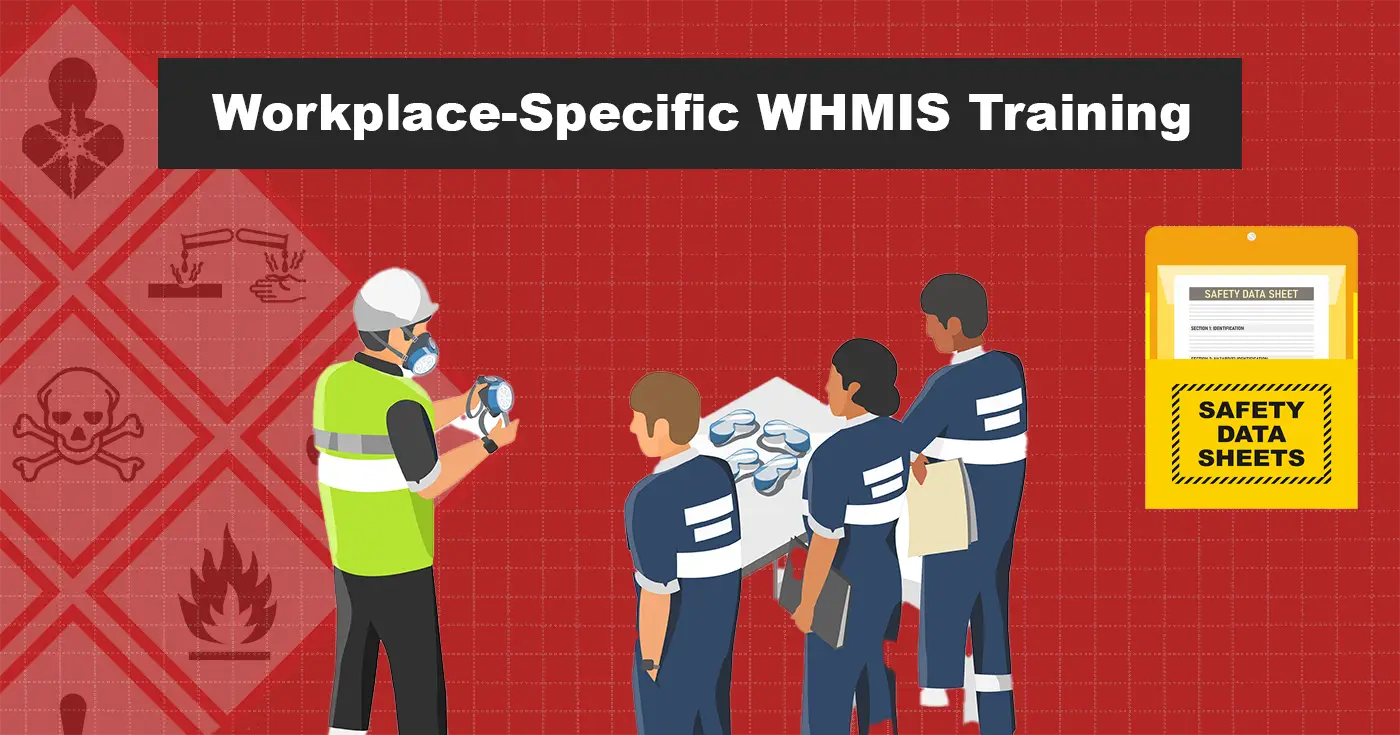
- Workplace-Specific WHMIS Training: Covers specific hazards, products, and procedures in the workplace. Must be provided by the employer.
As mentioned, most Canadian workers will receive WHMIS training at some point in their careers. But does that include both parts or just the general training?
Let’s dig deeper into who needs workplace-specific training.
Who Needs Workplace-Specific WHMIS Training?
Any employee who works with or around hazardous products needs to be provided with workplace-specific WHMIS training. This includes workers who directly work with chemicals and those whose jobs regularly bring them into areas where hazardous products are used or stored.
In most workplaces, that typically covers:
- Production and line workers who handle or use hazardous products as part of their tasks.
- Maintenance staff who service equipment that contains or uses hazardous products.
- Warehouse and logistics staff who receive, move, or store hazardous products.
- Lab or quality personnel who sample, test, or dispense hazardous substances.
- Cleaning and janitorial staff who use cleaning chemicals or enter chemical storage areas.
- Office staff who work in areas where chemicals are used or stored nearby.
- Supervisors who are responsible for promoting and enforcing WHMIS program requirements.
Generally, workers who require general WHMIS training will also require workplace-specific training.
Workplace-Specific WHMIS Training for Temporary Workers
Temporary workers need the same workplace-specific WHMIS training as any permanent employee performing the same work.
Their training often comes from two sources. The staffing agency provides general WHMIS training before placement. The host employer then provides workplace-specific training on the actual products, storage locations, handling procedures, and emergency response procedures at their facility.
Temporary workers should not begin work involving hazardous products until both components are completed.
When Should Workplace-Specific Training be Completed
Workplace-specific WHMIS training must be completed before a worker is exposed to hazardous products.
Beyond initial training, there are several situations that trigger the need for additional workplace-specific training:
New Hires: General training is typically completed during onboarding through online WHMIS training, before workplace-specific training. Once general training has been completed, you will follow with workplace-specific training to connect the foundation WHMIS knowledge to your actual products, storage locations, procedures, and emergency protocols.
New Hazardous Products: When a new hazardous product is introduced to the workplace, workers who will use or be exposed to it need training on that product. This includes reviewing the SDS, understanding safe handling procedures, and knowing what to do in the event of an incident.
Job or Department Changes: A worker transferring to a new role or department may be exposed to different hazardous products than they were previously exposed to. Even if they’ve been with the company for years, they need workplace-specific training for the new tasks and products before they start.
Process or Procedure Changes: If handling procedures, storage locations, ventilation controls, or emergency response protocols are changed, affected workers require updated training. The products might be the same, but how workers interact with them has changed.
After Incidents or Near-Misses: An incident involving a hazardous product, or a near-miss that could have resulted in exposure, often reveals gaps in training. Refresher training ensures workers understand what went wrong and how to prevent it.
When Workers Demonstrate Gaps in Knowledge: If a worker is observed to be handling products incorrectly, storing them improperly, or unable to locate safety information, that’s a signal that training is needed. Don’t wait for an incident.
Refresher Training: While WHMIS doesn’t have an explicit retraining frequency built into the standards, most employers retrain their workers every one to three years, as this is an industry best practice. It’s commonly agreed that exceeding three years without providing updated WHMIS training is generally a bad idea, as it increases the likelihood of injuries, illnesses, and legal issues.
What Should Workplace-Specific Training Include?
The thought of implementing workplace-specific WHMIS training can feel overwhelming, especially if you’re JUST learning that it’s a requirement.
You may not know what it should include, whether it should be the same for every employee, or even where to start.
Workplace-specific training isn’t one-size-fits-all for every employee in every workplace.
For example, an office worker who occasionally walks past a storage area doesn’t need the same training as someone on the shop floor who handles chemicals daily.
A warehouse employee who moves sealed containers needs different information than a technician who opens and mixes those same products.
The scope, detail, and duration of training should match the level of exposure and risk.
That said, workplace-specific training generally needs to cover:
- Hazardous Products Used in Your Workplace: The specific products workers will encounter in their role.
- Where those Products are Located: Storage areas, work stations, secondary containers.
- Where to find Safety Data Sheets: Physical location or digital access, and how to use them when needed.
- Safe Handling Procedures: How to use, store, and dispose of products specific to your facility.
- Required Personal Protective Equipment: What PPE is needed, where to access it, and how to use it.
- Emergency Procedures: What to do in case of a spill, exposure, or other incident, specific to your facility and products.
This might seem daunting and complex, but here’s the good news.
You have experts in your workplace.
They know what products are on site, who works with them, and what risks they present. That knowledge is what shapes the training.
Which means that designing workplace-specific training may actually be easier than you think. You already have the experts who can both design and deliver the training.
Next, we’ll cover who those experts are. Then, the specific strategies to design and facilitate workplace-specific training.
Who Can Deliver Workplace-Specific WHMIS Training?
Workplace-specific WHMIS training must be delivered by someone who understands your workplace, the hazardous products used, and how workers may be exposed during their normal job duties.
This does not mean employers need to hire an outside consultant or trainer. In fact, workplace-specific WHMIS training is usually most effective when it’s delivered by someone from your company who already understands the work being performed.
What matters most is that the person delivering the training has:
- Knowledge of the hazardous products present in the workplace.
- An understanding of how those products are used, stored, and controlled.
- The skills and ability to clearly communicate WHMIS concepts and site-specific safety procedures and guidelines to your workers.
Below are examples of employees in your organization who are well-positioned to deliver workplace-specific WHMIS training.
Supervisor or Manager
Supervisors and managers are often the most practical choice for delivering workplace-specific WHMIS training.
They typically have a strong understanding of:
- Day-to-day work activities.
- Where hazardous products are used or stored.
- The procedures workers are expected to follow.
By enhancing their instructional abilities through additional training, they can more effectively communicate workplace-specific WHMIS requirements when handling hazardous products.
Experienced Worker or Joint Health and Safety Committee Member
An experienced worker who regularly handles or works around hazardous products can also be an effective workplace-specific trainer.
These individuals often bring:
- Direct hands-on experience with the products and processes used on-site.
- Practical insight into exposure risks and controls.
- Strong credibility and trust with coworkers.
That said, experienced workers aren’t always accustomed to training others, let alone in WHMIS and other potentially complex safety topics.
With additional guidance and a structured approach, such as a WHMIS train-the-trainer program, their real-world experience can be translated into clear, job-relevant instruction that aligns with WHMIS expectations and workplace procedures.
Safety Manager or Coordinator
Safety Managers, coordinators, or designated safety representatives often already play a key role in supporting WHMIS programs.
They can inherently have a broader understanding of:
- WHMIS requirements.
- SDS management and updates
- Company-wide safety procedures
These individuals also typically have experience presenting safety topics and facilitating training sessions. Providing them with a WHMIS-specific train-the-trainer can further enhance their skills in ensuring they present key information accurately and effectively to your teams.
Choosing the Right Person
The most effective workplace-specific WHMIS training is delivered by someone who already understands your workplace and your hazards.
Supervisors, experienced workers, and safety personnel within an organization can use their existing knowledge and expertise to become highly effective WHMIS trainers.
With the right tools and preparation, they can deliver workplace-specific WHMIS training that meets regulatory requirements and ensures your workers understand how WHMIS applies to the specific products and conditions they’ll encounter on the job.
WHMIS Train-the-Trainer
Supervisors, experienced workers, and safety personnel already bring valuable knowledge of their workplace, hazardous products, and procedures.
However, there’s a difference between understanding how WHMIS applies to your workplace and knowing how to teach that information clearly, consistently, and effectively to others.
A WHMIS train-the-trainer program helps bridge that gap.
It provides internal trainers with a structured approach to delivering workplace-specific WHMIS training, including how to use Safety Data Sheets (SDSs during training, how to determine the appropriate level of detail for different roles, and how to document training properly.
Benefits of Completing a WHMIS Train-the-Trainer Program
Completing a WHMIS train-the-trainer program offers several practical benefits for employers, including the following:
Strengthens WHMIS Knowledge and Instructional Skills: A train-the-trainer program helps deepen a trainer’s understanding of WHMIS fundamentals, including hazardous product classification, SDS content, labels, and exposure risks. It also focuses on instructional techniques that help trainers communicate this information clearly and effectively to workers.
Ensures Compliance with Federal and Provincial WHMIS Requirements: Trained WHMIS instructors are better equipped to deliver consistent training that meets regulatory requirements. They understand what the standards require and how to document training properly, thereby protecting both your workers and your organization.
Improves Consistency Across Training: Trained internal instructors are better equipped to deliver workplace-specific WHMIS training in a consistent manner across departments, shifts, and job roles. This helps ensure workers receive accurate information that aligns with company procedures and WHMIS requirements.
Enhances the Use of Workplace Tools, Including Safety Data Sheets: A WHMIS train-the-trainer program teaches trainers how to utilize existing resources in the workplace, including SDSs, as practical training tools. Trainers learn how to identify relevant sections, focus on job-specific hazards, and explain controls and emergency procedures in a way that workers can apply on the job.
Builds Long-Term Internal Capability: Once your trainer completes the WHMIS train-the-trainer program, you have that capability in-house permanently. New hires, refresher training, procedure updates—you handle it all internally without scheduling outside consultants or waiting for the next available session.
Saves Time and Resources: Developing internal WHMIS trainers reduces the need for repeated outside training. Employers invest once in building internal capability and then use it repeatedly as training needs evolve.
How to Complete Workplace-Specific WHMIS Training
As we mentioned earlier, workplace-specific WHMIS training is often more straightforward than it sounds. You don’t need to create complex lesson plans or formal classroom sessions.
In most cases, the necessary information and expertise to complete workplace-specific WHMIS training already exist within the workplace.
The key is knowing how to use those resources effectively.
Let’s jump into Safety Data Sheets, your most valuable information resource for workplace-specific training.
Safety Data Sheets as a Foundation
Safety Data Sheets (SDSs) are the single most valuable resource employers have when designing workplace-specific WHMIS training.
Each SDS contains the information required to explain:
- The hazards a product poses.
- How workers may be exposed.
- How the product should be handled and stored.
- The exposure controls and required PPE.
- What to do in the event of a spill, exposure, or emergency.
These are the foundations of workplace-specific WHMIS training.
You don’t need to create training content from scratch. The SDS gives you the content. Your job is to connect that information to your specific workplace.
Practical Training Methods
There is no single “correct” method for delivering workplace-specific WHMIS training. The most effective approach depends on the products used, the tasks performed, and the level of risk associated with them.
As an employer, you have the option to implement methods that work best for your specific scenarios.
Here are some practical examples that you can use individually, together, or as a base for your training program.
SDS Review
One of the simplest and most effective methods is a complete review of an SDS directly with your workers. Here’s how a direct SDS review could look:
- Determine which products a worker or a group of workers uses.
- Print the SDSs or have them handy on a digital device, such as a tablet.
- Gather the worker(s) in a designated area where the product(s) are used.
- Review the relevant sections of the SDS with the workers.
- Communicate the routes of entry and specific dangers and health effects that exposure can result in.
- Communicate where the workers can find the SDS, required PPE, and other safety devices indicated on the SDS.
- Demonstrate applicable actions outlined in the SDS. For example, how to identify the correct PPE to use and how to don and doff it.
- Have the workers demonstrate those same actions while you observe and evaluate them to confirm they’re done correctly.
- Ask the workers questions relating to the SDS to confirm their understanding.
- Allow workers to ask questions for clarification to ensure their understanding.
- Document the practical training session with relevant details, including the names of the workers present, the date, and the topics covered during the training.
In some cases, multiple products may have the same requirements, allowing for consolidation of the review for greater efficiency. Just ensure that nothing is overlooked and that your employees have all the necessary information to stay safe.
Job or Task-Based Training
Another practical approach is to base training on the actual tasks workers perform.
For example, when workers use hazardous products as part of a specific task or process, tie the training directly to that task.
With this method, you’ll go through all the job steps and review the hazards and safeguarding controls in detail. You’ll cover the same information that we covered above in the SDS review, but it will be directly tied to each specific job task.
Integrate into Job Safety Analysis
If your workplace uses Job Safety Analyses (JSA or JHA), you already have a powerful framework for delivering workplace-specific WHMIS training.
A JSA breaks down a job into steps, identifies hazards at each step, and documents the controls required to perform the work safely. Most workplaces review JSAs with workers annually or whenever procedures change.
Here’s the opportunity: If hazardous products are part of the job, they should already be in the JSA. And if they’re in the JSA, your annual review can become workplace-specific WHMIS training, built directly into a process you’re already doing.
How to Integrate WHMIS into Your JSA Process
For each job that involves hazardous products, ensure the JSA includes:
- The specific hazardous products used — not just “chemicals” but the actual product names.
- Where in the task the products are used — at which step does exposure occur?
- What hazards those products present — flammability, corrosivity, toxicity, etc.
- What controls are in place — ventilation, substitution, administrative controls
- What PPE is required — and at which steps
- What to do if something goes wrong — spill response, first aid, who to contact
When you review the JSA with workers, you walk them through the task step by step, covering exactly how hazardous products fit into their work.
That’s workplace-specific WHMIS training. Contextualized, task-relevant, and tied directly to the work they actually perform.
Why This Works
Most employers struggle with workplace-specific WHMIS training because it feels like one more thing to schedule, track, and document separately. Integrating it into your JSA process solves that problem.
- Consolidation: You’re not running separate WHMIS sessions — it’s built into a process that already exists.
- Consistency: JSAs are typically reviewed on a set schedule. That means WHMIS refresher training happens consistently, not when someone remembers to do it.
- Relevance: Workers see how hazardous products fit into the actual task, not as an abstract safety topic disconnected from their job.
- Documentation: Your JSA review records serve as documentation that workplace-specific training has been completed, including who was trained, what was covered, and when.
Designing the Right Level of Training
The most important principle is this: Training should match the level of exposure and risk, and be specific to the products your workers are using or exposed to.
Not every worker requires the same level of training, and not every product necessitates the same degree of detail. SDSs, job tasks, and workplace conditions should guide:
- What information is covered.
- How detailed the training is.
- How it’s delivered.
- The duration of the training.
When you take this approach, workplace-specific WHMIS training becomes a practical, repeatable process.
Documenting Workplace-Specific Training
Workplace-specific WHMIS training must be documented.
Documentation indicates that training was completed, including what was covered and who received it. This supports due diligence if your program is ever reviewed following an inspection, incident, or audit.
Documentation does not need to be complex. In most cases, a simple record that includes the worker’s name, date of training, products or tasks covered, and the name of the person who delivered the training is sufficient.
Many employers use sign-off sheets, training logs, or JSA records to capture this information. The key is that records clearly demonstrate workplace-specific hazards and procedures were reviewed and understood.
When training is updated due to new products, task changes, or refresher requirements, the corresponding documentation should also be updated.
Keeping clear, consistent records helps employers track training completion, maintain continuity over time, and demonstrate that workplace-specific WHMIS training is an ongoing process, not a one-time event.
How Online WHMIS Training Fits into the Process
Online WHMIS training is used to complete the general training portion of WHMIS. It provides workers with a consistent foundation, including hazard classes, pictograms, labels, Safety Data Sheets, and general safe work principles.
Workplace-specific WHMIS training then builds on that foundation by applying the information to your actual products, tasks, and procedures. Because workers already understand how WHMIS works, supervisors and trainers can focus on reviewing SDSs, identifying site-specific hazards, and explaining controls, rather than re-teaching basic concepts.
Together, this method is commonly referred to as Blended WHMIS training.
Online training delivers the standardized knowledge efficiently, while workplace-specific training is completed internally.
For most Canadian employers, Blended WHMIS Training saves time, improves consistency, and makes it easier to maintain compliance as products, roles, and procedures change.
Common Mistakes Employers Make
Now that you understand how workplace-specific WHMIS training works, here are the most common mistakes to avoid:
Assuming general WHMIS training is enough: This is a common gap. Workers complete online or classroom WHMIS training, receive a certificate, and everyone assumes they’re fully trained. But without workplace-specific training, they don’t know which products are in your facility, where to find SDSs, or what to do if something goes wrong.
Delivering the same training to everyone: Not every worker needs the same depth of training. Someone handling corrosive chemicals daily requires more detailed instructions than someone who occasionally passes by a storage area. Match the training to the exposure and risk.
Training after exposure has already occurred: Workplace-specific training must happen before a worker is exposed to hazardous products, not during their first week, not when it’s convenient. If they’re working with or around hazardous products without training, you’re already out of compliance.
Forgetting temporary workers and contractors: Temporary workers and contractors need workplace-specific training just like permanent employees. The staffing agency may handle general WHMIS, but site-specific training is your responsibility as the host employer.
Not updating training when things change: New products, new procedures, new storage locations — any of these trigger the need for updated training. A worker trained two years ago on your old inventory isn’t trained on what’s in your facility today.
Making it more complicated than it needs to be: Workplace-specific training doesn’t require formal presentations or elaborate lesson plans. A detailed SDS review and a JSA review that covers all aspects of the products used can be valid and effective methods.
Failing to document: If it’s not documented, it didn’t happen. Keep records of who was trained, what was covered, when, and by whom. Simple is fine, but it needs to exist.
Conclusion
Workplace-specific WHMIS training doesn’t have to be complicated. You already have the expertise: supervisors, experienced workers, and safety personnel who understand your products, your processes, and your hazards.
You already have the resources: Safety Data Sheets that contain exactly the information your workers need.
And now, you have practical strategies to design and deliver training that fits your workplace.
The key is combining general WHMIS training with workplace-specific training to create a complete program.
General training builds the foundation, and Workplace-specific training connects that foundation to the actual products and procedures in your facility.
This blended approach is how leading employers in Canada complete their WHMIS training programs. It’s efficient, compliant, and sustainable as your workforce and products evolve over time.
OnlineWHMIS.ca provides the tools to make this easy.
Our online WHMIS training covers the general training component, which workers complete independently and receive documented proof of completion.
Our WHMIS train-the-trainer program helps prepare your internal team to deliver workplace-specific training with confidence and consistency.
Together, you have everything you need to build a complete, defensible WHMIS training program, without consultants, without complexity, and without disrupting your operation.
Frequently Asked Questions
How long does workplace-specific WHMIS training need to be?
There’s no mandated duration for workplace-specific WHMIS training, as every workplace and role is unique.
The training needs to be long enough for the worker to understand the specific hazards they’ll be exposed to and know how to protect themselves and their coworkers.
A worker who handles one lower-risk product may only need 15 minutes. A worker who mixes chemicals, wears respiratory protection, and works in a high-hazard environment may need significantly more time.
Does every worker need workplace-specific training?
Every worker who works with or around hazardous products needs workplace-specific training. If a worker has no exposure to hazardous products in their role, they don’t require it.
However, exposure could mean more than just direct handling, such as working in areas where hazardous products are stored, used, or transported.
The level of detail in the training should match the level of exposure. For example, the extent of training for a worker who occasionally passes through a storage area is significantly less than that of a worker who regularly handles a product.
Can I send my workers off-site for workplace-specific WHMIS training?
Workplace-specific WHMIS training cannot be completed off-site because it must cover your specific products, storage locations, handling procedures, and emergency protocols. An external trainer has never been to your facility and doesn’t know any of that information.
This is why workplace-specific training should be delivered internally by someone who understands your workplace.
Your supervisors, JHSC members, and safety professionals can make excellent internal trainers for workplace-specific training, especially when armed with a WHMIS train-the-trainer program.
Do I have to provide temporary workers with WHMIS training?
Yes. As the host employer, you’re responsible for providing temporary workers and staffing agencies placements with the same workplace-specific WHMIS training that your employees receive, if they are exposed to the same hazards. This responsibility cannot be delegated to a third party.
The staffing agency can, however, provide the general WHMIS training before sending the temporary worker to your site, and often does. This is typically in the form of online training, streamlining your process and saving you time and resources.
Can I buy a standard workplace-specific WHMIS training package?
Since workplace-specific training has to cover your actual products, storage locations, procedures, and emergency protocols, it cannot be purchased as a standard off-the-shelf package. No external provider can create that content without knowing your facility.
However, that doesn’t mean you’re on your own. There are tools that make designing and delivering workplace-specific training faster and easier. A WHMIS train-the-trainer program, for example, teaches your internal team how to utilize SDSs as training tools, how to determine the appropriate level of detail for different roles, and how to document training effectively.
The general training component can also be purchased in the form of online WHMIS training, which provides foundational knowledge, allowing your internal trainers to focus entirely on the workplace-specific portion.
Is workplace-specific WHMIS transferable between employers?
No, workplace-specific WHMIS training is not transferable between employers, as each workplace has unique factors relating to the products used, processes, policies, and procedures.
If a worker transfers from one employer to another, they will need to receive training that’s specific to that workplace.