
WHMIS 2025 Deadline | Are You Ready?
Table of Contents
Introduction
The WHMIS 2025 Deadline is almost here, and many employers are now taking a moment to make sure their WHMIS program reflects the updated requirements before the transition officially ends on December 14, 2025.
Since the most recent WHMIS update in December 2022, suppliers have been gradually updating their classifications, labels, and Safety Data Sheets (SDSs).
If you haven’t been tracking every update along the way, don’t worry—you’re not alone. Many or most workplaces have simply continued using the SDSs and labels provided by their suppliers while those updates rolled out in the background.
Now that we’re entering the final stretch, employers are double-checking their documentation, training, and workplace procedures to ensure everything is aligned heading into 2026.
In this guide, we’ll walk through what has actually changed, what you should confirm before the deadline, and what WHMIS looks like moving forward.
Whether you’ve been following the updates closely or you’re reviewing things now for the first time, this article gives you a clear, practical overview to stay compliant without overcomplicating the process.
What are the WHMIS Changes: A Quick Recap
WHMIS went through its most recent update in December 2022, when Health Canada amended the Hazardous Products Regulations (HPR) to align with a more recent revision of the GHS. These amendments introduced new hazard classes, updated classification criteria, and revised SDS and label requirements.
If you haven’t reviewed the changes yet, here’s a quick recap of what’s changed.
Why Was WHMIS Updated?
The goal of the December 2022 WHMIS amendments was to:
- Align more closely with the 7th revised edition of the Globally Harmonized System (GHS), plus parts of the 8th.
- Improve clarity in hazard communication.
- Make SDS and label information more accurate and consistent across suppliers.
For employers, this means updated hazard information, clearer statements, and more standardized SDS formatting.
When Was WHMIS Updated?
You may have heard the term “WHMIS 2023”. This is likely because the updated Hazardous Products Regulations were published in the Canada Gazette on January 4, 2023. However, the amendments technically came into force on December 15, 2022, which is also the date the transition period started.
That transition period gave suppliers, employers, and workers time to adjust to the updated requirements—including revised classifications, new SDS formats, and updated labels.
The WHMIS 2025 Deadline (December 14, 2025) marks the end of this transition.
Key Changes for WHMIS 2025 Deadline
These are the updates employers will most commonly see as they receive new SDSs and labels from suppliers:
New hazard class: Chemicals Under Pressure: A completely new category covering products that contain gases under pressure with added flammable or oxidizing components.
Revised Flammable Gases categories (1A and 1B): Flammable gases are now split into clearer subcategories.Category 1A now includes pyrophoric gases and chemically unstable gases, which were previously handled separately.
New Aerosols Category 3 (non-flammable aerosols): Aerosols have been reorganized and now include a new category for non-flammable aerosols.
Updates to Desensitized Explosives: Criteria were revised to more accurately reflect how these products behave under different conditions.
More detailed SDS Requirements: Section 9 now includes particle characteristics and updated physical property fields. This is why some SDSs will look noticeably different moving forward.
Clearer Ingredient Disclosure Rules: Suppliers must now list all hazardous ingredients above cut-off levels, even if they don’t change the overall classification.
Updated Hazard and Precautionary Statements: Some statements have been rewritten to improve clarity and consistency.
What this Means for Employers
These updates are intended to improve accuracy and worker understanding—not complicate your WHMIS program.
Employers mainly need to:
- Recognize that updated SDSs and labels may look different.
- Make sure workers understand the updated WHMIS.
- Ensure workplace procedures and training reflect the amended requirements.
Deadline Requirements: Confirming Your Compliant
With the WHMIS 2025 Deadline approaching, most employers are doing a final check to make sure everything in their WHMIS program lines up with the updated requirements.
Luckily, if you already have a comprehensive WHMIS program, the update process is less of an overhaul and more of tweak and polish. Most importantly it’s about ensuring the information workers rely on to stay safe is accurate, current, and consistent.
Here are elements that should be reviewed as the transition period wraps up.
Review Your SDS Library
Updated SDSs are one of the most noticeable changes under the amended WHMIS requirements.
Evaluate your product inventory and ensure you have the most recent and up-to-date SDS for each of your products.
Many employers are already seeing:
- Revised hazard classifications.
- Expanded physical and chemical data, especially in Section 9.
- Updated precautionary and hazard statements.
Safety Data Sheets are a key resource that your teams use to verify hazard information, safehanding procedures, and first aid measures, so it’s critical that they are updated.
If any SDSs appears to follow the older format, request an updated version from your supplier.
Check WHMIS Labels
Supplier labels should already reflect any updated classifications, but workplace labels you create may not.
Review the labels on secondary containers and any in-house labeling systems to ensure they:
- Match the product’s current classification
- Display the correct pictograms and hazard statements
- Do not reference outdated WHMIS terminology or categories
This is also a good time to tidy up labels that are worn, unclear, or inconsistent with the latest SDS.
The goal is to ensure workers aren’t receiving conflicting information depending on which container they pick up.
Update WHMIS Training
Workers should receive updated WHMIS training that reflects the relevant changes introduced through the amendments. Remember, WHMIS training is made up of two components:
- General WHMIS Training (can be completed in a classroom or online).
- Workplace-Specific WHMIS Training (must reflect your workplace and the specific products being used).
We’ll cover WHMIS training in more detail in a dedicated section below.
Communicate Changes to Your Team
Workers will likely notice differences in SDS formatting or hazard statements, and a quick explanation helps prevent confusion. Let them know:
- Why SDSs may look different.
- That some products may now fall under updated hazard classes.
- That they should review the updated documents and ask questions if something is unclear.
Clear communication reinforces safe practices and ensures the transition doesn’t create uncertainty.
New Training Requirements for 2026?
As the transition period ends, many employers are wondering whether there’s a new WHMIS 2026 training.
While there isn’t a new version of WHMIS being introduced in 2026, workers must still receive updated training that reflects the amended requirements.
This includes both General WHMIS Training (Education) and Workplace-Specific WHMIS Training.
General WHMIS Training
General WHMIS training, often referred to as “Education” should be aligned with the most recent revisions to WHMIS. This part of the training can be completed via classroom training or online training and covers the following topics:
- WHMIS fundamentals and legislation
- Duties and Responsibilities
- Hazard Classification and Pictograms
- How to Read Labels
- How to Read Safety Data Sheets
- General Safety Guidelines
General training can typically be complete in about an hour to 1.5 hours.
Workplace-Specific WHMIS Training
In most cases, employers will need to provide workplace-specific training to employees who use or work around hazards products. Many employers find it challenging or confusing as to the methods in which they can create and provide this component of the training.
One of the most valuable resources for workplace-specific WHMIS training are the SDS’s for the products being used.
An SDS contains highly specific information about the safety measures that must be taken when using the product, the PPE that needs to be used, how the product should be handled and cleaned-up, and first aid measures in the case of exposure.
One basic method of providing workplace-specific training could include:
- Reviewing the relevant sections of an SDS with the workers.
- Explaining the negative health effects of the product.
- Demonstrating the safe handling measures outlined in the SDS.
- Explaining when to use PPE and demonstrating how it’s donned.
- Explaining and/or demonstrating first aid measures if an exposure occurs.
The extent and duration of the workplace-specific training you provide to your team will depend heavily on several factors. This includes the type of industry you’re in, the specific processes in your operations, and most important, the types of hazardous products your team works with or around.
Need Help Getting Your Team Up to Date?
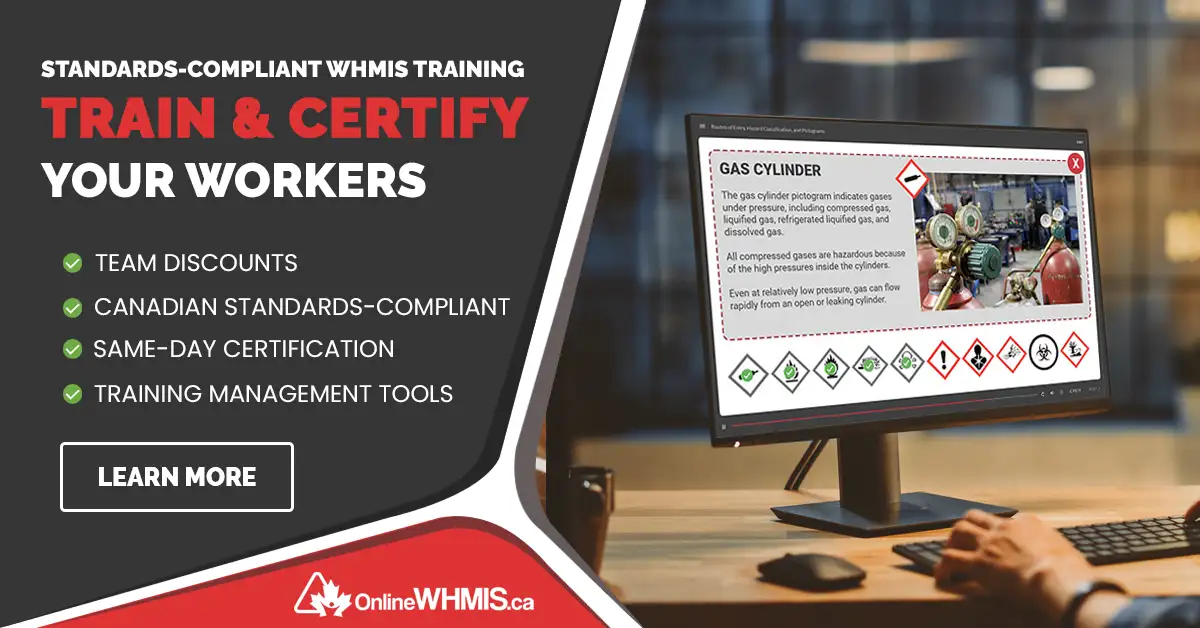
If you want a simple, reliable way to train your workers, our online WHMIS training is easy to roll out across your entire team. Workers can take the training anytime, from any device, and complete it without interrupting your workflow.
Our online whmis training includes:
- Bulk discounts
- Easy group enrollment options
- Automatic recordkeeping and training reports
- Instant, same-day certificates for every worker
- Consistent, high-quality training that’s updated to align with the recent revision.
Whether you’re training new workers or refreshing existing staff, OnlineWHMIS.ca gives you a fast, flexible way to keep everyone up to date.
Frequently Asked Questions
What are the 2025 changes to WHMIS?
There are no new WHMIS changes taking effect in 2025. The most recent update occurred when the amended Hazardous Products Regulations came into force on December 15, 2022.
People often refer to “2025 changes” because the transition period ends on December 14, 2025. After this date, suppliers must follow the amended HPR, and employers should ensure their WHMIS program reflects the updated requirements—meaning updated SDSs, consistent workplace labels, and WHMIS training that covers the amended system.
When is the 2025 WHMIS deadline?
The WHMIS Deadline or, WHMIS transition period, ends on December 14, 2025. After this date, suppliers must fully comply with the amended HPR, which means employers should only be receiving updated SDSs and labels.
Employers are responsible for making sure their SDS library reflects the most current versions provided, updating any workplace labels as needed, and ensuring workers are trained on the amended WHMIS requirements.
Do workers need updated WHMIS training before the deadline?
Yes. Workers should be trained on the current WHMIS system. That includes the updated hazard classes, revised statements, and the expanded SDS format.
Employers must update both general WHMIS training and workplace-specific training to reflect any changes in products, hazards, or procedures in the workplace.
Is Your WHMIS Course Up-to-Date for the 2025 WHMIS Deadline?
Yes! Our training was updated to align with the revision in early 2023, so it does meet the general training requirements for the 2025 deadline. Remember, you will likely need to provide workplace-specific training to your workers as well, regardless of where you source your general training.
Does supervisors need WHMIS training?
Yes. If supervisors oversee employees who work with or around hazardous products, they must also receive WHMIS training. This training ensures supervisors can promote, enforce, and support WHMIS compliance, as required by law.
At OnlineWHMIS.ca, we offer a supervisor-specific WHMIS course specifically designed to support supervisors in promoting and enforcing WHMIS requirements. You can learn more here: WHMIS for Managers and Supervisors
Do WHMIS Certificates need to display a year, like 2025?
No. WHMIS no longer uses year-based versions, and certificates do not need a “2025,” “2026,” or any other year printed on them. What matters is that employers provide WHMIS training that reflects the current requirements and supplement it with workplace-specific instruction.
Does WHMIS change again in 2026?
No. WHMIS does not update again in 2026. The WHMIS 2025 Deadline marks the end of the transition period for the 2022 amendments. WHMIS continues as WHMIS, and employers must ensure workers stay trained on the system currently in place.